 |
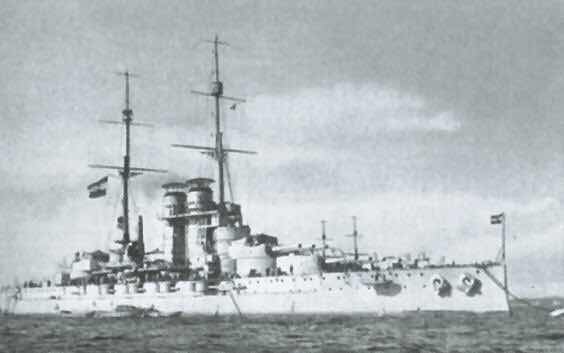
| SMS Szent István, Austro-Hungary's newest battleship |
By May 1918 the Austro-Hungarian surface fleet was in
crisis. Four years of relative inaction had led to severe unrest amongst the
crews and on some of the ships they had already risen in open revolt. At the
base at Cattaro on the 1st February 1918 the Red flag was raised
over the Armoured cruiser SMS Sankt Georg
and was joined by other ships including pre-dreadnought Monarch and cruiser Kaiser Karl IV as well as other ships in port whether they agreed with the mutiny or to
avoid being shelled by the larger ships. Demands were handed to the shore
commander Kontreadmiral Hansa demanding better conditions for sailors, a
democratic style government, freedom from Germany and above all Peace. Most of
these demands were beyond the ability of Hansa to permit and the Army Garrison
commander threatened to bring artillery out to shell the mutineers. The light
cruisers SMS Helgoland and Novaro, with a flotilla of loyal torpedo
boats, moved out of range of the mutineers then raised the Imperial flag and
were joined by U-boats from the German U-boat station but the senior officer Linienschiffskapitän
Heyssler aboard Helgoland was loathed
to sink very valuable ships and waste lives. On the 3rd February the
Third Battle fleet consisting of the Pre-dreadnought’s SMS Erzherog Karl, Erzherog Franz Ferdinand and Zrinyi arrived and the rebellion rapidly
petered out and Hansa and all the officers were freed. Order was restored with
the arrest of some 800 mutineers and the execution of four ringleaders
including Franz Rasch.
Elsewhere sailors were sabotaging the war effort with a force of sixty Italian speaking sailors under Fregattenleutnant Veith being captured at Ancona after being betrayed to the Carabinieri by some of their own number before they could sabotage the sugar refinery and MAS (Motoscafi Antisommgibil – Motor Torpedo boats) in the harbour on the night of 5-6 April. Elsewhere Linienschiffeleutnant Nikos Horthy reported his crew refused meals and duties until he personally inspected the vessel and brought charges to the ring leaders.
As a reaction to these events the Austrian High Command forcibly retired older Admirals and officers or redistributed them to shore commands whilst promoting younger officers, a move that saw a reluctant Horthy promoted to Commander of the Adriatic fleet and a promotion to Kontreadmiral. After taking command another incident occurred with two crewmen of a destroyer that was due to escort a convoy to Albania, plotting to overthrow the officers and defect to the enemy. The plot never gained ground and Horthy signed the orders to execute the two men.
Horthy believed that there could be only one recourse to quell the mutinies and sedition recording in his memoirs that the:
Best way to restore discipline in the Navy would be to put the ships into action, a view that was shared by our colleagues of the German Navy. The men who had not yet heard a shot fired in anger must be shaken out of their lethargy. (1)
When he was stationed on a cruiser inactive he had observed that:
This particular command gave me no joy. Inactive, we were moored to a buoy, and had to watch cruisers, destroyers, torpedo-boats and U-boats sail away and return, happily engrossed in their heavy duties. Among those who were gay after days, endangering their lives, traitors were not found. (2)
The German Naval mission to the Austro-Hungarian Empire was growing alarmed at the events unfolding at the mouth of the Adriatic as well. Since the attack on the Otranto Barrage the Allies had strengthened their defences with a total of forty Royal Navy destroyers (including six Australians) and twelve French destroyers which operated in patrols of 6-10 vessels day and night whilst the fleet of thirty-five trawlers with hydrophones sat north of the barrage listening for submarines in passage covered by a growing aerial patrol. To the south lay eighteen American wooden submarine chasers whilst mines lay at 60 feet below the surface near Otranto and others were connected to nets that would pull them up into submerged U-boats making the transit a very tricky affair. The German officers were keen to protect the exceptionally valuable U-boats and during April five had been attacked trying to cross the barrage and eight in May with SMS UB-52 being sunk by the British submarine HMS H4. They wanted the Austrians to act in support of the U-boats and after a raid on the barrage by Austrian destroyers in April was successfully repulsed by Allied destroyers without loss, a grander scheme had to be undertaken.
There was also a much bigger issue that was concerning the German Admiralstab and it went far beyond the Adriatic. With the collapse of the Russian war effort there was a move for Germany and her Allies to take control of the vessels of the Black Sea fleet including powerful dreadnoughts and submarines before linking with the Turkish fleet and heading down the Bospherous and into the Mediterranean seriously affecting the balance of power which may cause to call for reinforcements from the Grand Fleet which would in turn affect the blockade of Germany and the balance of power with the High Sea’s fleet. Having an active Austro-Hungarian fleet would further spread the Allies’ ships. As it was the Allied Naval council wanted to redistribute the fleets to meet a possible threat from the Black sea with the French dreadnoughts and the Danton class pre-Dreadnoughts to the Aegean and the five Italian dreadnoughts, the pride of their fleet, to be placed under French command at Corfu where they could simultaneously be used to check the Austrians and be in reserve should the new threat materialise. The Allied Council were concerned, however that the Italian force was not large enough to hold the four Tegetthof dreadnoughts and the four pre-dreadnoughts should the Austrians sail en-masse.

The Allies were also far from pleased with the strength of the Barrage estimating that in both April and May it had been breached fifty times by submarines going in or out and that shipping was still being sunk at the same rate as it had the previous year including the troop transport SS Leasowe Castle which was sunk 104 miles WNW of Alexandria carrying 3000 soldiers to Marseille. The troop ship was part of convoy of six troopships escorted by Japanese and British destroyers and was intercepted by SM Ub-51 under the command of Kapitänleutnant Ernst Kraft at 12:25 a.m.. The ship was operating a blackout with some of soldiers sleeping on deck at their action stations but the convoy was well lit by the full moon. The torpedo struck amidships under the funnel on the starboard side. Disaster was avoided with the ship coming to a halt and sinking slowly whilst the troops were paraded and put into lifeboats in an orderly fashion with the IJN destroyer Katsura and the sloop HMS Lily taking soldiers out of the boats and sending them back for more from the stricken vessel. In all only 101 of the ship’s company and troops went down with the ship including her master, Captain E. J. Holt.
The Austrian plan took into account the experiences of the previous year’s attack on the Barrage combining a powerful attack on the light forces that constituted it with overwhelming force combined with supporting vessels to cover the withdrawal who would ensnare any pursuers including, as Horthy was predicting battle-cruisers. The attack was timed to coincide with General Boroevič's offensive across the Piave river with the main attack would be carried out by the four Tegetthof dreadnoughts working in pairs before withdrawing towards Pola having done enough damage before the Allied Navy responded. The Austro-Hungarian fleet was hoping to ensnare and sink the predicted battle-cruisers and any pursuing Allied vessels in a way that they almost managed the previous year. Twelve Austro-Hungarian U-boats were placed at favourable points through the Adriatic to catch the Allies unawares whilst the three Erzherzog class pre-dreadnoughts were arranged in a line running north to south level with Durazio whilst a rapid reaction force of four Novara class cruisers and eight Tatra class destroyers were assembled at Cattaro ready to respond.
Elsewhere sailors were sabotaging the war effort with a force of sixty Italian speaking sailors under Fregattenleutnant Veith being captured at Ancona after being betrayed to the Carabinieri by some of their own number before they could sabotage the sugar refinery and MAS (Motoscafi Antisommgibil – Motor Torpedo boats) in the harbour on the night of 5-6 April. Elsewhere Linienschiffeleutnant Nikos Horthy reported his crew refused meals and duties until he personally inspected the vessel and brought charges to the ring leaders.
As a reaction to these events the Austrian High Command forcibly retired older Admirals and officers or redistributed them to shore commands whilst promoting younger officers, a move that saw a reluctant Horthy promoted to Commander of the Adriatic fleet and a promotion to Kontreadmiral. After taking command another incident occurred with two crewmen of a destroyer that was due to escort a convoy to Albania, plotting to overthrow the officers and defect to the enemy. The plot never gained ground and Horthy signed the orders to execute the two men.
Horthy believed that there could be only one recourse to quell the mutinies and sedition recording in his memoirs that the:
Best way to restore discipline in the Navy would be to put the ships into action, a view that was shared by our colleagues of the German Navy. The men who had not yet heard a shot fired in anger must be shaken out of their lethargy. (1)
When he was stationed on a cruiser inactive he had observed that:
This particular command gave me no joy. Inactive, we were moored to a buoy, and had to watch cruisers, destroyers, torpedo-boats and U-boats sail away and return, happily engrossed in their heavy duties. Among those who were gay after days, endangering their lives, traitors were not found. (2)
The German Naval mission to the Austro-Hungarian Empire was growing alarmed at the events unfolding at the mouth of the Adriatic as well. Since the attack on the Otranto Barrage the Allies had strengthened their defences with a total of forty Royal Navy destroyers (including six Australians) and twelve French destroyers which operated in patrols of 6-10 vessels day and night whilst the fleet of thirty-five trawlers with hydrophones sat north of the barrage listening for submarines in passage covered by a growing aerial patrol. To the south lay eighteen American wooden submarine chasers whilst mines lay at 60 feet below the surface near Otranto and others were connected to nets that would pull them up into submerged U-boats making the transit a very tricky affair. The German officers were keen to protect the exceptionally valuable U-boats and during April five had been attacked trying to cross the barrage and eight in May with SMS UB-52 being sunk by the British submarine HMS H4. They wanted the Austrians to act in support of the U-boats and after a raid on the barrage by Austrian destroyers in April was successfully repulsed by Allied destroyers without loss, a grander scheme had to be undertaken.
There was also a much bigger issue that was concerning the German Admiralstab and it went far beyond the Adriatic. With the collapse of the Russian war effort there was a move for Germany and her Allies to take control of the vessels of the Black Sea fleet including powerful dreadnoughts and submarines before linking with the Turkish fleet and heading down the Bospherous and into the Mediterranean seriously affecting the balance of power which may cause to call for reinforcements from the Grand Fleet which would in turn affect the blockade of Germany and the balance of power with the High Sea’s fleet. Having an active Austro-Hungarian fleet would further spread the Allies’ ships. As it was the Allied Naval council wanted to redistribute the fleets to meet a possible threat from the Black sea with the French dreadnoughts and the Danton class pre-Dreadnoughts to the Aegean and the five Italian dreadnoughts, the pride of their fleet, to be placed under French command at Corfu where they could simultaneously be used to check the Austrians and be in reserve should the new threat materialise. The Allied Council were concerned, however that the Italian force was not large enough to hold the four Tegetthof dreadnoughts and the four pre-dreadnoughts should the Austrians sail en-masse.
The Allies were also far from pleased with the strength of the Barrage estimating that in both April and May it had been breached fifty times by submarines going in or out and that shipping was still being sunk at the same rate as it had the previous year including the troop transport SS Leasowe Castle which was sunk 104 miles WNW of Alexandria carrying 3000 soldiers to Marseille. The troop ship was part of convoy of six troopships escorted by Japanese and British destroyers and was intercepted by SM Ub-51 under the command of Kapitänleutnant Ernst Kraft at 12:25 a.m.. The ship was operating a blackout with some of soldiers sleeping on deck at their action stations but the convoy was well lit by the full moon. The torpedo struck amidships under the funnel on the starboard side. Disaster was avoided with the ship coming to a halt and sinking slowly whilst the troops were paraded and put into lifeboats in an orderly fashion with the IJN destroyer Katsura and the sloop HMS Lily taking soldiers out of the boats and sending them back for more from the stricken vessel. In all only 101 of the ship’s company and troops went down with the ship including her master, Captain E. J. Holt.
The Austrian plan took into account the experiences of the previous year’s attack on the Barrage combining a powerful attack on the light forces that constituted it with overwhelming force combined with supporting vessels to cover the withdrawal who would ensnare any pursuers including, as Horthy was predicting battle-cruisers. The attack was timed to coincide with General Boroevič's offensive across the Piave river with the main attack would be carried out by the four Tegetthof dreadnoughts working in pairs before withdrawing towards Pola having done enough damage before the Allied Navy responded. The Austro-Hungarian fleet was hoping to ensnare and sink the predicted battle-cruisers and any pursuing Allied vessels in a way that they almost managed the previous year. Twelve Austro-Hungarian U-boats were placed at favourable points through the Adriatic to catch the Allies unawares whilst the three Erzherzog class pre-dreadnoughts were arranged in a line running north to south level with Durazio whilst a rapid reaction force of four Novara class cruisers and eight Tatra class destroyers were assembled at Cattaro ready to respond.
The Szent István was the newest of the Tegetthof class dreadnoughts, having come into service in 1915. The Tegetthof class were broadly similar to the Nassau class battleships and were considered fairly compact and well armoured and were armed with four turrets housing three 30.5cm guns as the primary weapons, the first battleships to be armed like this. Unlike her sisters, the Szent István had two shafts and propellers but had a top speed of 20 knots with coal soaked in oil to increase its burn rate. The Szent István was also the only Tegetthof to be built at a Hungarian dockyard, by the Ganz and Company’s Danubius yard at Flume in Croatia and was the first major warship built at the yard with the yard itself having to be refitted to carry out the work. The ship was laid down on the 29th January 1912 following the Hungarian government ratifying the 1910 and 1911 Naval budgets, something that the land locked nation was often loathed to do.
The early life of the Szent István was marked with disaster and complications. On the day that she was launched, 17th January 1914, an anchor chain fell killing a dock worker and injuring another/ The vessel was also the only major warship in the fleet that did not have the Emperor present at the launch as Franz Josef I was ill and Archduke Franz Ferdinand was so anti-Hungarian that he refused to go. After the rocky start the Szent István’s career was somewhat unglamorous with her construction being halted by the start of the First World War with her final completion date being 13th December 1915. Unlike her sisters she never left Pola except for routine gunnery training until she received her orders for the Operation against the Barrage and only fired her anti-aircraft guns in anger as the Italians launched some eighty air raids on the Austro-Hungarian fleet between 1915 and 1917.
On the 8th June Admiral Horthy lead the 1st Division consisting of the Szent István’s sisters SMS Viribus Unitis and Prinz Eugen out of Pola at dusk and arriving at Slano by dawn and waited for the 2nd Division to get into position. Captain Seitz led SMS Tegetthof and the Szent István out of port on the night of 9th June and after an initial delay caused by Tegetthof suffering engine difficulties and by the defensive boom across the Pola harbour not being retracted, the force of two dreadnoughts and their escorting destroyers and torpedo boats headed through the Dalmatian archipelago for Isoa Grossa where they would wait for the allotted time to begin a coordinated attack on the Barrage.
The 2nd Division were not the only vessels who were delayed that night. The Italian torpedo boats MAS 15 and MAS 21 were floating off the island of Lutostrak with one of the two suffering its own engine problems at 3:15 a.m. on the morning of 10th June having been dispatched from Ancona by the base commander Calleani for a routine patrol of the Dalmatian coast under the command of Capitino di Corvetta Luigi Rizzo. Lookouts reported heavy smoke coming south and soon the two Austro-Hungarian battleships were sighed. Rizzo made the decision to attack as he could not out run the Austrians and there was a chance that they could do some damage and escape.
Orders were passed and the two MAS slowed their engines so that no white wash would betray their position and they managed to pass between two of the Austrian destroyer escorts and close to the two dreadnoughts at 3:35 a.m. and quickly powered up their engines approaching to 300 yards of the towering Austrian vessels. Capoltimoniere Armando Gori’s MAS 15 targeted the Szent István whilst Guardiamarina di complemento Giuseppe Aonzo’s MAS 21 attacked the Tegetthof both firing two torpedoes. With two torpedoes passing the SMS Tegetthof she immediately took avoiding action and believing that an Allied submarine was in the area began to zig-zag and fired upon phantom periscopes. The two Italian vessels turned for home pursued by the Austrian escorts with the Huszár class destroyer SMS Velebit being forced to give up the pursuit after a depth charge was dropped by one of the MAS and exploded underneath it!
The Szent István was not so fortunate and was struck by two torpedoes abreast of her boiler rooms penetrating both boiler rooms with the hole made worse by poor quality riveting.
The Situation aboard was somewhat bleak with severe flooding occurring in the aft boiler rooms and the dreadnought began to list to starboard by 10°. Action was quickly taken with the magazines flooded which reduced the list to 7° whilst collision nets were deployed to try and cover the torpedo holes but to no avail. The decision was made to turn the vessel and aim for nearby Bay of Beguije on the Isle of Molat at low speed but with the unimpaired flooding dousing the fires in the boiler rooms and the loss of electricity the ship’s fate was sealed.
Following the Tegetthof’s return at 4:45 a.m. she
attempted to tow her wounded sister but all attempts were fruitless as was
turning the guns to port to redistribute the weight and counter the list as
well as jettisoning all of the ready ammunition. Slowly the vessel began to
capsize and at 6:05 a.m. on the 10th June she slipped beneath the
waves taking 89 sailors with her out of a crew of 1041 with the rest of the
Austrian vessels picking up the survivors. Concern spread as to the cause of
the sinking and a belief that they had been betrayed rather than poor luck and lack
of anti torpedo defences filled the fleet, Admiral Horthy later commented in
his Memoirs that the Sinking;
Meant that the enemy could
no longer be taken by surprise, for the Italian would have given the alar and
we would have to face forces far superior in the neighbourhood of the Otranto
Barrage that we had contemplated. With heavy heart, I decided to call of the
attack and gave the order for the ships to return to Pola. (3)
For the Austro-Hungarian Navy it had been a last roll of the
dice and for the surface fleet it was the end of the war though Szent István was not the last Tegetthoff
to be sunk with Viribus Unitis being
sunk later that year by Italian frogmen.

1 - Horthy, M. "Memoirs" Hutchinson & Co, London, P.89


