Sunday, 17 August 2014

The fate of the German "Australian Station"

At the start of the First World War the German Navy (Kaiserliche-marine) was divided into two main fleets with a Home port each and several smaller stations with responsibility over their areas which usually lay with the senior Captain taking charge of the vessels in time of emergency if no Flag officer was present.

Outside of the Grand Fleet there was the East Asia Squadron under Admiral von Spee with the cruisers Scharnhorst, and Gneisnau forming the core and the light cruisers Leipzig and Nürnberg. The light cruiser Emden was based in the home port, the Chinese concession of Tsingtao for defence. Smaller groups included the Schutztruppe in East Africa based at Dar Es Salaam (which consisted of the light cruiser Konigsberg) and the Australian station, based at Apia, tasked with patrols of the German islands of Samoa, Solomon Islands, Marianas, Marshal Is., Naura, Palau and Papau New Guinea. The vessels attached to the station were the survey vessel Planet and the Bussard class cruiser Cormoran.

Cormoran (Cormorant) was laid down in 1890 at Danzig with final completion on 25th July 1893.
SMS Cormoran
Armed with two deck mounted torpedo tubes, eight quick firing 10.5cm Sk l/35 guns on single pedestal mounts with 100 rounds each (range of up to 10,800 metres) scattered with two at the front, two on each side and two at the back. There was also five revolver cannon. The Bussard class were the last class of cruiser to be fitted with sailing rig as well as coal fired engines. As an "Unprotected" cruiser the Bussard class lacked side armour and all important deck armour protecting the vital equipment within the vessel. Eventually the Naval race between England and Germany meant designs leapt and bounded past them leaving them obsolete for fleet engagements but useful to carry out patrol ship duties, especially in the colonies and the islands of Australasia. She was never going to be the power in any particular water but against the isolated islands and for policing she was more than formidable. After a long career in Pacific waters carrying out various tasks including supressing two rebellions (once with the aid of the Kreuzerwaffe of the East Asian squadron), Cormoran was downgraded as a cruiser to a gunboat on 24th February 1913 by order of Admiral Tirpitz. Cormoran moved to Tsingtao for a refit on 30th May 1914. As war approached the senior Naval officer in Tsingtao, Kapitan Karl von Müller of the Emden ordered the repairs to Cormoran accelerated so that she could be sea worthy should war start. Emden left Tsingtao to go hunting just as war seemed imminent hoping to catch Russian warships at sea unaware. When she returned with the Russian freighter Ryazan in tow on the 4th August the situation had accelerated with Great Britain declaring war and Müller made the decision to abandon repair work on Cormoran and move her crew and guns over to Ryazan along with crewmen from the gunships Iltis, Luchs and Tiger as well as some war volunteers. The vessel was renamed SMH Cormoran II. The Cormoran was eventually scuttled by the Imperial Dockyard staff on the 28th-9th September to stop her from being captured.

Meanwhile her sister ship Geier (Vulture) was dispatched to replace her on the Australian station. The Geier had previously replaced another Bussard class cruiser, See-Adler, in East Africa and sailed from Taganyika for Tsingtao and stopped at Singapore to recoal and resupply. Hearing rumours of war about to break in Europe and aware of being in a British port the cruiser and her collier Bochum fled the Royal Navy and headed out to sea on the 29th July. Royal Navy intelligence passed to Admiral Jerream of the Chinese station stated that the Gneisnau instead of Geier had fled Singapore which shows how unreliable the observations and intelligence could be.

The Geier and Bochum managed to avoid the Royal Navy virtually disappearing and becoming a virtual threat that could have been a threat to merchant vessels and troop transports making the journey without escorts. She, like Emden and Spee's squadron were ghosts that were everywhere and nowhere. However Geier received orders from the admiralty to find the other vessel from the Australian squadron, the SMS Planet which was heading to Yap island to defend the important German Radio and supply base in the Caroline Islands. Once found she was to transfer her guns and torpedo tubes to the already lightly armed (3 revolver cannons) Planet and defend the island from any attack as best they could, failing that release the Planet for commerce raiding.

Geier was supposed to meet with the supply ship Tannenfels (which had also fled Singapore on the 2nd August) loaded with 8500 tonnes of coal aboard that had been bought in Batavia but the collier never appeared at the rendezvous. Luckily for the Geier they did come across the Emshorn which transferred 1300 tonnes to the German cruiser and 1700 tonnes to Bochum before departing to try and make contact with von Spee’s ships but with the British capturing and destroying German radio stations and Spee operating under W/T silence the chances of finding them was very low, especially as Spee was heading due East at a faster speed than the old Geier could muster. The only other major German warship in Asian waters did make contact and after a missed meeting at Anguar on the 20th August, Geier met with Emden and her collier Markommania at sea where the Geier’s Korvettenkapitän Grasshoff was ferried over to speak to Kapitan von Müller. No doubt they discussed the situation at length. It was decided that Geier would proceed to Anguar and not accompany Emden, possibly because she would slow down the bigger cruiser and be a liability if they were engaged by any Naval units. Geier taking on the mantle of a loan raider made things harder for the Royal Navy. With two separate units attacking targets in different areas it would cause confusion and chaos. If one were captured or sunk then the other would still be at sea. It was probably at this juncture that the decision to not get to the Planet was formalised and the junction at Yap Island written off, Geier would not make it before the Allies arrived and if they did they would surely be outnumbered, outclassed and out gunned by any Allied invasion force. Staying at sea was the only viable option.

As Emden made for the Molucca strait Geier turned for Anguar with Bochum. On arrival the empty supply ship was replaced with the supply ship Locksun (carrying 2000 tonnes of coal) and the Tsingtao (carrying 2300 tonnes of coal.) Locksun was ordered ahead to the Majuro atoll in the Marshall Islands whilst Tsingtao accompanied Grasshoff to New Hannover but Tsingtao was far from perfect as a supply ship, the coal it carried was Japanese and of a poor quality, it also had limited supplies and even lacked a water distillery for fresh water so had to use the Geier’s water distillery which meant regular stops to transfer water.

On the 4th September at the island of Kusaie Geier surprised and captured the British freighter SS
SMS Geier
Southport
and boarded her. Captain Clopet told the Germans he had been at sea and had no idea that Engalnd and Germany were at war. Taking them at their word the German boarding party decided not to scuttle the vessel and instead disabled the engines and disposed of tools that would aid in its repair before promptly disappearing again. The situation on Southport was bleak, it would take a miracle to get the engines working again but with pure determination from Clopet and his engineer Mr H Cox they managed to jury rig the engines to work in a very flimsy manner – it wouldn’t go backwards and they were was a strong concern that should they ever stop they may not get it to go again. This was coupled with the 2000 miles to the nearest British port and a severe lack of supplies. The Germans had told the local tribal king to supply the British ship with as much supplies as they could whilst it remained at the island and Clopet was able to barter for 350lb of coconuts and 400lb of a local root that the natives would eat for sustenance when all other food ran out, then he gave the order to set sail. On the 30th September Southport pulled into Brisbane harbour and it became one of the great tales of British seamanship, doing the impossible and news of the Geier’s last known position was reported to the Admiralty but it was almost a month out of date. 


Now with the Locksun supporting her Geier continued its cruise around the Pacific but as coal supplies dried up the collier had to tow Geier when a recoaling at sea had to be abandoned due to rough weather and seas. Grasshoff had to change his plans again. He had hoped to get to San Francisco and surrender to the neutral Americans before he was caught by the Allies in open water, sadly his shortages of supplies meant that he would have to find a closer port to put into. On 15th October the two vessels put into Honolulu harbour. According to international law neutral ports were only meant to allow warships of belligerent nations up to twenty-four hours to resupply and do minor repairs but as there was a lot of anti-British feeling amongst the Americans and the islanders the Geier was given an extension of three weeks! 
 On 23rd October at 23:30 the USCRS Thetis spotted two steam powered launches acting strangely out in the harbour and signalled them to no avail, it lowered a boat and attempted to board one of them and fired a blank round from its’ 3lb deck gun causing the two ships to disappear into the night. The next morning the sun rose to reveal the battleship IJS Hizen and armoured cruiser Asama, with them was the German schooner Aeolus which the Japanese had caught just outside Honolulu harbour with its cargo of Copra. The Japanese were transferring the German captives to the Loksun in the harbour as well as taking the Copra aboard their vessels. Hizen’s launches continued to violate American territorial waters with their launches being chased by Thetis on several occasions including ordering the Japanese crews off the Hermes, another German trader overtaken and boarded within the three mile exclusion zone and ripping down the German flag. Captain Schmidt protested with the Japanese sailors claiming asylum and hoisted it back up as Thetis came closer threatening the Japanese with her guns. Hermes was greeted with cheers from the two German vessels already in port after the Japanese were forced to abandon their attempted capture. Hizen’s Captain claimed in an interview that he intended on waiting for Geier to come out and would stick to the rules of neutrality rigidly but every night his vessels would harry shipping within the boundary limits and the US navy sent out a further two launches from Pearl Harbour to aid Thetis, the actions of the Japanese did nothing to ingratiate them or the Allied cause to the Americans on the island.

With the amount of neutral shipping, including Japanese and German, operating in Hawaiian waters it would have been exceptionally disruptive should Geier take to sea and Grasshoff must have known that his vessel would have been doomed against the two heavier Japanese units and so it was decided to plead for asylum and internment at Honolulu, an action that satisfied all three parties and on 8th November it became official and the two Japanese vessels left for San Clemente.


Three years later Geier was seized by American forces when the US joined the Allied cause against Germany. Her crew was taken into POW camps and the vessel renamed USS Schurz and refitted for escort duties. After various duties she was eventually sunk in a collision with a merchant vessel (SS Florida) which cut a sizable chunk out of her bow killing one crewman and injuring twelve. The order to abandon ship was given and on 21st June 1918 she sank beneath the waves.

SMS Planet

The other vessel in the station, the aforementioned survey vessel SMS Planet was scuttled on 7th October 1914 at Yap island to stop her capture by the approaching Japanese expeditionary force and her crew were transferred to the SMH Cormoran
II, her wreck was later salvaged by Japan in 1916. With nothing more than three 3.7 cm revolver cannons she stood little chance of defending herself or the colony nor much chance of escape. Grasshoff's decision to not go to Yap was a wise one as his vessel would not have made any difference and both vessels would have been lost that day. He, like Spee took the gamble that should (when) Germany win the war, their colonies would be returned to them.

The German Australian squadron was not a war winning squadron, thousands of miles from the High seas fleet with obsolete vessels unsuited to war with the other Imperial powers and with only a limited ability against merchant shipping as their supply bases were quickly over run. The only hope for them would be to join up with Spee's East Asian squadron but they would be a hinderance to his larger vessels as traversed the ocean for Germany and would have been destroyed quickly in any major engagement. Their fate was sealed the day Britain and Japan entered the war and it was only a matter of time before they were forced to scuttle or be interned.

Friday, 8 August 2014

Escape of SMS Goeben and Breslau

SMS Goeben
It was 2.45am on 6th August 1914, and conditions on Rear Admiral Troubridge's flagship Defence were tense as in a little over three hours the first Cruiser squadron of the Mediterranean fleet consisting of the light cruisers Black Prince, Duke of Edinburgh, Warrior and Defence, with a screen of destroyers would be engaging the German battle-cruiser Goeben and her escort Breslau.

Throughout the night the squadron's men were preparing themselves mentally for the roar of the guns, explosions and the very real possibility that they could be killed and this was something that was preying on the mind of Captain Fawcett Wray when he stepped into the Admiral's chart room.

"Are you going to fight sir? Because if so the Squadron ought to know." He asked.

"Yes, I know it is wrong but I cannot have the name of the whole Mediterranean squadron stink" came the reply.

Obviously concerned by the answer Captain Wray, normally over confident and sure of his abilities voiced his concerns about the one sided nature of the upcoming battle. Goeben had almost twice the displacement of each of his cruisers, a slightly less weighty broadside but she was faster with bigger guns with longer range. Wray had been looking at these sums and that in daylight Goeben could rain down her 11" shells well out of range of the British squadron and use her superior speed to stay out of the British range. Wray finished his evaluation with the icy observation;

"It seems to me it is likely to be the suicide of your squadron."

       ***             ***          ***           ***         ***        ***        ***         ***       ***           ***        

Goeben and Breslau had been in the Mediterranean since 1912 patrolling the Balkans during the recent conflicts and flying the flag for Germany in the region. Goeben was a relatively new design having been completed in 1911 and dispatched before her sea trials had been completed and she had some on going boiler issues. Breslau, a light Magdeburg class cruiser was also constructed in 1911 and was similarly dispatched with the duty of escorting Goeben.

HMS Indefatigable one of three cruisers that could have sunk Goeben
As tensions grew in Europe grew Admiral Souchon the C-in-C of the Mediterranean squadron put into Pola, the Austro-Hungerian main Naval base and had his vessels overhauled and formed strategy with his counterpart Admiral Haus. It was decided on the outbreak of hostilities that the German and Austro Hungarian fleet would sail to the West of the Mediterranean and intercept the French XIX army corps that would be undoubtedly be transported by individual ships and covered by the French fleet spread out across the 3-400 miles route.

The German fleet had put into Messina on 2nd August to re-coal for a patrol and found facilities severely lacking. Souchon confiscated the German liner General and moved her crew over the Goeben  as well as a sizable chunk of coal whilst removing any unnecessary equipment from his vessels and stowed them. They pulled out of the harbour on the 3rd August at 1 am, slipped around the north coast at 16-17 knots heading for the ports of Phillipeville and Bône. At 6pm they received confirmation that Germany was at war with France. They accordingly divided then and headed for their targets.

The French fleet had also left port at Toulon on the 3rd August to escort the XIX army corps, however Admiral Lapeyrère had deployed his fleet into three sections to escort the transports in convoy rather than forming a broad front.

The Royal Navy under Admiral Archibald Berkeley Milne had also divided its forces with Rear Admiral Troubridge being dispatched with the first cruiser squadron to watch the Adriatic in case the Austro-Hungarian fleet should leave Pola. Milne was directed to remain with his other ships (Chatham, Weymouth) in case Admiral Souchon turned west or headed for the Atlantic. None of those were Milne's decisions, they came directly from London in a telegram on the 2nd August.

The lengthy message outline what Milne should do completely. His primary duty was to protect the French convoys, bring to action any individual fast ships but not to engage a superior force without French support.
Troubridge made clear to Milne that he believed that Goeben was a superior force to his cruisers, Milne was not worried.
"That question won't arise as you will have Indoubtable and Indefatigable with you."
Indeed the two I class cruisers with their 12" guns gave Troubridge an edge should battle with Goeben occur, they could engage her in a gun duel whilst the smaller cruisers and destroyers got closer for their guns and torpedoes. Their presence would also make the Austro-Hungarian fleet think twice. So with those two vessels, the cruisers Duke of Edingburgh, Black Prince, Defence, Warrior, the light cruiser Gloucester, and eight destroyers at 8pm on 2nd August.

The Germans made the first move. Despite receiving a telegram from his superiors in Berlin maked "Urgent" Souchon decided to press ahead with his original orders, which the new orders did not countermand. Goeben bombarded Phillipeville with fifteen shells before withdrawing. These were no transports laden with troops, no docked warships, no stocks of ammunition. Breslau found the same at Bône so Souchon ordered the withdrawal to save ammunition. He feinted westward before changing course north before looking at his new orders. Admiral Tirpitz was ordering his force to head east for the Bospherous with all due haste and then on to Constantinople. The idea behind it was to present the new ships to the Ottoman Empire replacing the two British build dreadnaughts that were confiscated by the admiralty before hostilities began.

At 10:30am, three and a half hour's before Great Britain's ultimatum was delieverd to Germany, Goeben and Breslau encountered Indomitable and Indefatigable, who had been ordered by the Admiralty (via Milne) to reverse course and head for Gibraltar in case the German squadron was heading west. As the two squadrons passed their main turrets turned to face each other and with each side eying each other suspiciously none of the customary courtesy signals were sent. As Goeben passed the two Royal Navy cruisers turned to pursue at a distance but keeping enough speed in reserve. Admiral Souchon must have intercepted the message from the Admiralty to Captain Kennedy about the British Ultimatum to Germany because he ordered more speed. In the Goeben's boiler room on a hot summer day the German stokers toiled so hard that they began to suffer from heat exhaustion, many passing out over their shovels and being carried out to lay on the relative cool air of the deck then at a critical moment there was a mechanical failure that released a cloud of red hot steam that scalded four men to death, but the orders held and the officers continued to press their men on. Slowly but surely she made headway over her pursuers who although of a comparable speed were in need of engine maintenance and their bellies scraping and they were unable to keep pace, even the light cruiser Dublin who managed another hour was forced to give up the chase sending the following signal to Milne at 7.37pm.

"Goeben out of sight now, can only see smoke, still daylight."

Later that night Admiral Milne was informed that both German ships had entered Messina harbour which threw up some new problems for the Royal Navy.

The good news was that they knew where Goeben was. The bad news was that he didn't know where they would go. The rumour of a German collier in Majorca weighed on his (and the Admiralty's) mind and the belief that the German ships would ignore the heavily defended French convoys and head out to terrorise the unprotected merchant ships in the Atlantic.

His hands were then tied by the Admiralty with a signal at 18:00 with the announcement of Italy's declaration of neutrality and banning any of His Majesty's ships from going within six miles of the Italian coastline, this would stop him from sailing down the straits of Messina or face violating international law. The best he could do was to deploy his ships at each end of the straits. Admiral Fisher (later First Sea lord) Commented afterwards that;

(Milne) "had no excuses whatever for not surrounding Messina with all his entire force right round the harbour mouth - close up! As if international law mattered a Damn! and the Italians would have loved him forever!"

Indeed when it came to international law the Royal Navy did not hesitate when it came to the Battle of Más a Tierra when HMS Kent and Glasgow violated Chilean neutrality to sink SMS Dresden which only led to the German consulate complaining. Although Italy was not Chile and the British government did not wish to provoke Italy despite their stance against Austria. However Milne lacked the flare to act independently, as was his right as the C-in-C on the spot.
 
Admiral Souchon in Turkish uniform
They pay me to be an Admiral, they don't pay me to think.

So Milne stuck rigidly to the orders he was given by the Admiralty in London. Troubridge was left at the mouth of the Adriatic watching for the Austrian fleet which he was capable of holding or slowing and waiting for Milne's squadron for reinforcements as long as the Austrian dreadnaughts did not sail.

Milne spread his I-class cruisers between Sicily and Tunisia in case the German Division did make aGloucester waited at the other end of the strait of Messina ready to tail the Germans.
move towards the French transports whilst he patrolled the North coast of Sicily with his other ships. The superior French fleet which could have decided the outcome could not be contacted and remained and unquantifiable. HMS

Souchon was having to make some hard choices as well. The Italians had given him a strict twenty four hour deadline and the coal stokes were severely lacking, there would not be enough to make it to Turkey. He confiscated as much coal as he could from any and all of the German vessels present ripping up their deck plates to speed up the process but it was still not enough. He also knew that the Royal Navy would be surrounding Sicily the situation was getting tough. He also received a signal saying that the Turkey order was not definite and that his reception was not guaranteed. Logically only the Austro-Hungarian fleet was safe, but how long before the Allies came for them and they were trapped in the Adriatic?

He decided to roll the dice and Goeben and Breslau slipped out of port at nightfall on the 6th August heading south through the straits and arranging to meet a collier in the Aegean islands. Milne heard that they had left and immediately redeployed his vessels heading west and then south to catch the Germans as they sailed around Sicily and slipped west which the Admiralty was certain they would do.

Souchon didn't know where the Royal Navy was and was concerned that with the amount of time needed to coal up he could find his small fleet being caught in the islands where they couldn't manoeuvre and taken apart. Goeben's engines were also playing up as they had been pressed hard in the last pursuit and he could not guarantee they could reach that speed again. There was another more pressing problem. He was being pursued by HMS Gloucester.

The light cruiser was dogged in her pursuit holding at 26 knots she refused to budge and even steered between Goeben and the shore to force the Germans to make a wider turn and slow down further. Breslau quickly dropped back fearing a torpedo attack on the lead German vessel and started making threatening passes and looking like she might fire at any time. Realising that the Germans could easily disable his vessel Captain Kelly ordered his ship to pull back and using the moonlight keep watch and signal Admiral Milne of their position. Admiral Troubridge was ordered to bring his fleet of cruisers, the light cruiser Dublin and his destroyers to intercept the Germans. At first confused by the heading and Goeben's feint Troubridge delayed his departure thinking he was going to turn north towards him but when it became clear from Captain Kelly's updates that the German's were still heading south east he ordered the fleet to make all due haste to meet them. According to estimates he should arrive in the vicinity of Goeben and Breslau at 6.30am. He signalled Dublin and Gloucester which arrived at 2.54am;

"First Cruiser squadron position 2.30 am 38 ̊ 25'N, 20 ̊ O'E Course south 20 knots. Am endeavouring to cross Goeben's bows at 6am."

Now Admiral Troubridge was waiting for his Navigator and said to Wray;

"I cannot turn away now, think of my pride!"

"Has your pride got anything to do with it sir? It is your country's welfare which is at stake" came the measured response.

After listening to the navigator with Captain Wray as they discussed the chances of his fleet getting through the up coming combat. It didn't look good. It was as they feared, the chances of them being able to get close enough to the German battle cruiser which had proved so amazingly fast against the two I-class battle cruisers just a few days before was very small. It seemed Wray's evaluation was correct. With tears in his eyes Troubridge ordered the end to the pursuit at 4am on the 7th August. Wray commented that;

"That was the bravest thing you have ever done in your life."

It is debated by historians and by the Admiralty in the enquiry and Troubridge's court martial as to whether he had done the right thing. Arguably with luck and a good amount of skill Troubridge could have damaged Goeben enough to slow her down or in best case scenario sunk her. The problem was how many of the Royal Navy ships would have gone down with her? Wray's theory might very well have come true and with Breslau running interference it could have become very dicey. There was also the confirmation that without the I-class cruisers that Goeben constituted a "superior force" as outlined by the Admiralty's prior orders, if anything Troubridge was following orders which is why he was eventually acquitted. At the battle of Jutland in 1916 HMS Defence did come into combat with German warships and was sunk after receiving seven strikes. Also at Jutland was Seydlitz, a similar vessel to Goeben took twenty-two 12" shells and thirteen to fifteen 15" shells which was a lot more powerful than the 9.2" guns Defence and the rest of Troubridge's squadron were sporting. In the enquiry Milne was asked what he considered were the most important factors to naval combat and he argued it was: "Gun power, weather and speed" so didn't consider armour worthy of note but it would have been the deciding factor for Troubridge's squadron.

At 4.49 am Troubridge signalled Milne to request orders and to report his decision.

"Why did you not continue to cut off Goeben? She only going 17 knots, and so important to bring her to action." was the reply.

For the first time Troubridge explained his actions in a very lengthy message at 8.30am:

"With visibility at the time I could have been sighted from twenty to twenty-five miles away and could never have got nearer unless Goeben wished to bring me to action which she could not have done under circumstances most advantageous to her. I could never have brought her to action. I had hoped to have engaged her at three thirty in the morning in dim light but had gone north first with the objective of engaging her at the entrance of the Adriatic.
I was too late to intercept her when she altered course to the south. In view of the intense importance of victory or defeat at such early stages of a war I would consider it a great imprudence to place Squadron in such a position as to be picked off at leisure and sunk while unable to effectively reply. The decision is not the easiest of the two to make. I am well aware."

Elsewhere that morning as Souchon's men had been unable to jam Kelly's transmissions the Breslau took positive steps to shake off their pursuer and with a need to shake them before coaling. She began weaving across the path of Gloucester as if laying mines. Captain Kelly ordered his 6" guns to fire on the German ship hitting with one shell beneath the waterline. Breslau began to rain down accurate fire upon the smaller British ship but unperturbed Captain Kelly urged his vessel to close the range so he could use his full broadside and torpedoes on the light German vessel. Pin pricks of light on the silhouette of Goeben meant only one thing and as two white columns of water confirmed Captain Kelly's fear, Souchon had ordered his vessel to slow and turn and bring his long range guns to bear on him. Kelly knew the odds and ordered his vessel to drop back signalling Milne at 2.45pm that:

"Have engaged at long range with Breslau and retreated when Goeben turned. I am now following again."

Souchon must have been very worried as with a light cruiser pushing at his fleet it could only mean that the Royal Navy were closing in on him. He must have been relieved to see Gloucester drop away at 4pm low on coal and following orders from Milne not to go further than Mataban and sent a final signal registering the German's course for the Aegean.

It wasn't until the early morning on the 8th August, some twenty four hours later that Admiral Milne would set off from Malta, 460 miles to the west with his three I-class cruisers and Weymouth to find Goeben. He would later site that HMS Indomitable which had been ready to sail on the 7th could not have gone alone as she was suffering from boiler issues and waited for his force to go en-masse. Still thinking Souchon was feinting took his time sailing at 10 knots awaiting the Admiralty to tell him good news.

Admiral Souchon met up with a collier in the Greek islands and began the lengthy process of fully coaling up for the last leg to the Bospherous, all the time listening to the Royal Navy's W/T transmissions getting closer and closer. Luckily for him the indecision of Admiral Milne and Troubridge's returning to the Adriatic meant he had enough time to carry out the operation without harassment on the 9th August. They made off at full speed and reached the Dardenelles on the 10th August at 5pm and received an escort through the minefield up to Constantinople, transferring his vessels to the Turkish navy on the 16th. It was a close run thing as Milne's vessels smoke could be seen coming over the horizon as they entered the Turkish mine fields. When Milne did arrive he was refused permission to give chase and was forced to stop.

The pursuit was viewed as a victory in the British press and celebrated as an example of the Royal Navy sweeping up the Mediterranean and the cowardly Germans running for safety rather than standing and fighting Milne's vessels. The Admiralty were not of the same opinion. The investigation into Troubridge's actions warranted a court martial for failing to engage but he was eventually acquitted due to the Admiralty's foggy order not to engage a superior force and what a superior force consisted of. Although considered blameless Troubridge and Milne's careers never recovered and they soon lost their posts being promoted sideways. Souchon however was promoted to Commander in Chief of the Turkish fleet on 23rd September 1914 and by November Turkey had joined the Central powers in their war against the Allies which led to the Gallipoli campaign as well as Britain's war in Mesopotamia and Palestine causing more deaths and casualties.


Condensed from the (hopefully) upcoming Kindle book "Evaders; Spee and Souchon against the Royal Navy" by C. Sams

Sunday, 6 July 2014

Captain Benteen's orders

Benteen during the Civil War
Captain Frederick Benteen of the US 7th Cavalry took stock of the situation that was before him and was forced to make a decision, a decision that he has been criticised for since that fateful day on 25th June, 1875 on the banks of the Little Big Horn river.

He decided to disobey orders from his direct superior, Lt Col George Armstrong Custer, the CO of the regiment, and not advance to meet him and instead hold position with the embattled Major Reno.

The action definitely saved Benteen's three companies and the Ammunition train but also saved Major Reno's survivors from annihilation, but some argue doomed Custer's forces to death.

Custer's whole approach towards the Indian village was flawed from the beginning, it worked on the assumption that they would be rounding up women and children and that the braves would be out fought by the brave soldiers of the 7th Cavalry or flee before them. Custer was impatient and would not wait for the infantry column, nor would he take a battery of heavy Gatling guns because they would slow his advance. His aim was to move as quickly as possible living on the run like the  Native Americans did and the Gatlings, which required four horses each would slow down the advance and he wanted to catch the tribes before they dispersed. He also turned down assistance from the 2nd Cavalry believing that his men were the best and could defeat anyone.

There is some merit in his not taking the Gatling guns as they were prone to jam and as his unit would travel at thirty miles a day, average, they would have indeed impeded his advance. The arm chair tactician and many fellow officers at the time agree that having the ability to have a battery of guns that could fire 350 rounds a minute would have been devastating if deployed against a charging enemy.

On approaching the hostile country Custer's lack of intelligence and knowledge of the lay of the land or his enemies numbers or dispositions became evident and he began to divide his forces to scout them out and to give himself warning. Benteen's three companies were deployed on the far left to scout through rough terrain and make sure there would be no surprises for the rest of the column.

The rest of the command moved forward and sighted the Native encampment that his Crow scouts had reported as the biggest village they had ever seen. Custer believed that he was only going to face 800 warriors and the majority of the village were women and children. He divided his forces again to try and stop the Natives fleeing to the south, Custer's lion's share of the regiment would swoop in from the North as Reno struck from the South catching the them in a Hammer and Anvil manoeuvre that would force the natives to surrender (to avoid fighting amongst their Women and children) and submit to escort back to the reservation. He also believed that most of the braves were asleep in their tepees and would be caught out.

His hand was then forced when his scouts arrived to tell him that native riders had picked up his trail and were following him and that they had been sighted on the bluffs above Custer's position. If he didn't strike now, the initiative would be lost and the natives would disperse into smaller groups and flee which would be impossible to catch.

Reno's men advanced towards the village from the south with their flank covered by thick foliage and their view of the village likewise blocked and his men charged full speed abreast until they came around the river bend and were suddenly met with the enormity of the Native encampment. Had his forces been armed with Sabres they could have cut through cutting and slashing as they went causing chaos. As it was Custer had forbidden the 7th from carrying sabres. Reno's only hope was that if he formed a tight knit firing line and hoping that massed rifle fire would stop a counter charge and provide the anvil that Custer had wanted. Standard procedure was for the troopers to form into groups of three riflemen and a fourth to hold the horses in case they needed to break. He held a good position with the river to his front and the impassable brambles on the right and they began regular volley fire. Then it all started to go wrong as the Natives began to respond, they saw his vulnerable left side and began to attack it and even setting fire to the long grass forcing the men to withdraw. Their superior numbers began to tell and Reno would later testify he believed they were five to one. Finally when one of his Arikara interpreters, Bloody knife, was killed and his blood and brains covered the major's face. Reno's nerve broke and he called out to his men;

All those who wish to make their escape follow me!

There followed a rout as Reno led his men backwards towards the bluffs at their rear in complete disorder.

The exact nature of Custer's movements are unknown but as the 210 men approached the village, possibly trying to ford the river at Minneconjou ford at the centre of the village but were repulsed by a handful of sharpshooters. The native oral history makes claim that Custer was killed her as an officer in buckskin next to a standard bearer was shot dead into the water. Custer's body was found further north with the rest of his troopers so it is unlikely but someone certainly fell here.

Cooke's written order with Benteen's translation on the top.
 Custer took stock of the situation and the numbers of natives who were aligned against him and passed an order to his adjutant, the Canadian 1st Lieutenant William W. Cooke. The order was written hurriedly and thrust into the hands of sergeant Giovanni Martino, one of the buglers to deliver directly to the hands of Captain Benteen.

It read simply: Benteen come on. Big village, bring packs. W. W. Cooke. P.s. bring packs.

Knowing the pack mules were following behind slowly and not knowing what action was facing him ahead Benteen ordered his men to rest and water the horses for twenty minutes before advancing. Again he has been criticised for this decision but it is a reasonable action for a cavalry officer expecting action for you'd want fresh horses to face a charge. He claimed at the Reno enquiry that he asked Trumpeter Martin about what was ahead and he said that the "Indians were skedaddling"1 and saw no rush to follow up at speed.  He eventually moved off and arrived at Reno's position by complete coincidence and made that fateful decision.

As he approached he saw a fire fight up on the bluffs and thought it was the whole regiment and began to advance towards them, suddenly seeing a group of Tribesmen he charged with his orderly before finally recognising them as Crow scouts - they told him it was not going well, fearing that the force on the bluffs was the whole regiment having been whipped he moved to join forces and assess the situation.

The situation was bleak, the ammunition pack train was about an hour and a half away, natives were firing on Reno's position and they had taken losses in the disorderly flight. At the Reno hearing he described that Reno's men were in good order and that Reno had regained his composure, his men were still scattered around the bluffs for individual preference for firing but in relative good order, the nearest natives were about a mile away and there were some 900 Indians circling nearby but out of range.

Reno told Benteen that he had no idea where Custer and his 210 men were, they had followed the orders that had been issued with the understanding that Custer would support them as they advanced. That was the last order he had received. Benteen showed him the order he had received but then decided that he would be better placed to defend Reno's shattered forces. His men joined their tired and wounded comrades and began digging rifle fire pits to better protect the men and keep their firing rate up.

Captain Thomas Weir requested permission to ride towards the sound of volley fire stating they had a duty to try to reach the rest of the regiment and support their Commanding officer. Reno and Benteen refused to budge and Weir, without orders, charged forward with his troopers but they only managed to push forward for a mile before they were forced to retire again by large numbers of tribesmen. All that they could see of Custer's men was swirling dust and gunfire. It was already too late.

Benteen believed that they were under attack from up to eight thousand Natives and the fire became more lively, so much so that; You only had to show a hat or a head or anything, to get a volley toward it. 2 As Custer's men were firing their last shots the Sioux turned and headed in full force against Reno. Benteen's account describes a harrowing evening and night with the Natives shooting at anything that moved followed by heavy fire the next day. Rudimentary breast works were dug and Benteen led a charge to clear the enemy from the ravine before retiring back towards the summit of the bluffs and they dug in and waited around their horses and the ammunition train.

So did Benteen make the right decision? Should he have followed his orders without question towards Custer?

In short, I think he made the right decision to disregard the order. Had Benteen ignored Reno's position and forced their way towards Custer they would have been destroyed too. Reno's forces were shattered and short of ammunition and could not have moved out in any sense of order and without attracting the fire from below. Captain Weir's advance took place only thirty minutes after Benteen arrived and they were forced to withdraw quite quickly and that was before the ammunition mules had arrived. Benteen had no knowledge of what was ahead of him nor the exact position of Custer nor the number of enemies he was facing. The situation was totally untenable and without the information or the ammunition he could go nowhere. Had he advanced it would have been likely that his three companies would have been caught out on the trot and met the same fate as Custer leaving the Sioux able to cut what was left of Reno's forces to shreds.

Two men did leave the ammunition train, Boston Custer (the colonel's brother) and Henry Reed (his nephew). They went at full speed to Custer's side where they were killed.

Benteen's three companies could not save the lives of Custer's 210 men but they did save the lives of Reno's as well as their own.

Friday, 6 June 2014

Operation Banquet - British bombers over the beaches

Tiger moth Trainers were to carry out Banquet
Desperate times call for desperate measures and never has Great Britain been as desperate as it was in
the summer of 1940.

As 2400 German aircraft bombarded the RAF's fighter command and around 3000 barges were being pooled to transfer the 6th and 9th Armies across the English Channel. The British Military began looking at contingences in case the RAF were unable to overcome the odds.

As the majority of the light and medium bombers would be ear marked for attacking the heavily defended invasion fleet and ports, a new plan had to be organised for attacking the beaches and on the 13th July a survey of available aircraft for operations was ordered. The solution was Operation Banquet.

Banquet was divided into several different phases depending on where the aircraft were coming from be it Banquet Civil (using Civilian aircraft - which was dropped quickly), Banquet 6 (absorption of some of Group 6 units), Banquet 22 (absorbing 22 group army co-operation units), Banquet Alert (Fleet air arm training units under RAF Costal command) and Banquet Training. In all 350 aircraft of various types and quality were thrown together for this last ditch exercise.

Banquet Training and Alert are the most concerning as they consisted of trainee pilots considered to be of "a certain level of ability" and their instructors.

The aircraft they were to be assigned were modified Tiger moth trainer bi-planes which lacked basic defensive armament, self sealing fuel tanks or armour. They also lacked bombsights and only had racks that had been designed for small bombs weighing about 9kg.

The general plan was for the Tiger Moths to fly over the target once to identify it and then turn around and go into a shallow dive and release their bombs. these small bombs would have been very ineffective against enemy armour but could have proved deadly to infantry on the ground.

The problem was that the Tiger Moths would be attacking individually with only a handful of bombs under fire from anything the German's could fire at them and with the lack of armour and slow speed would have meant that even the small arms fire carried by infantrymen could have brought the planes down.

Further to that the inexperienced pilots would have been easy pickings in their trudging bi-planes to the Bf 109 E fighters.

The pilots spent the summer of 1940 practicing bombing but due to shortages the Tiger moths were flown from the front cockpits whilst a second man dropped bricks out of the rear cockpit to simulate the drop.

Paddy Denton, a young Bomber Command trainee had this to say of Banquet.

It was an indication of how ill prepared for war we, as a nation were. When there was some sort of threat of attack, presumably from the sea, some of the more serviceable Tiger moths were fitted with bomb racks and tiny little bombs, about 3lb, I would have thought.
These appalling threats to an invader were rehearsed without the benefit of Bombsight or anything so sophisticated by a neat HEAT Robinson device of little leavers in front of the intrepid aviator.
The experience did make me ponder about the possible outcome of the war.
(Bomber Crew, P. 43)

There was also another branch of Banquet that had Tiger Moths fitted with long metallic blades with the notion that they would fly through clouds of paratroopers and cut their parachute chords or the unfortunate soldiers in half immune from enemy fire as they would be in close proximity to their own troops!

So could Banquet have been pulled off?

In the desperate times of a German invasion of the British Isles there is no doubt that these 350 aircraft would have been thrown at the beaches swarming with German soldiers or concentrations of Paratroopers and a sizable chunk may have actually reached their targets.

The Luftwaffe fielded approximately 600 Bf 109s which had the task of providing escorts to any bomber attacks, sweeping the beaches to protect the infantry and forming an aerial umbrella over the landing craft to protect against the RAF's other bombers. All this over a front stretching from the Isle of Wight to Ramsgate! It would be fair to say they would have been very stretched allowing the aircraft of Banquet to get through.

There is also a good chance that the Tiger moths would have been difficult to intercept due to their slow speed. In the hands of a good pilot a biplane can avoid getting hit by rolling away. By the time the 109 realised they had missed and come around the Biplane would have got away. Sadly these would not be experienced pilots and their unarmoured crates would have broken up after a few rounds.

The biggest risk would have come from ground fire and although the soldiers would have had more pressing issues, like British machine gun posts and hard points, there is no doubt some form of defensive fire would have been thrown up .

Banquet would have been an unpleasant surprise for a German invader and I have no doubt that in Britain's most desperate hour these aircraft would have taken off. It would have been a gallant yet bloody defence of England's shores.

Thursday, 5 June 2014

Feldwebel Severloh's stand at Omaha beach

US troops preparing to land at Omaha
Tomorrow (6th June) is the 70th anniversary of the D-day landings in Normandy. The landings are

the largest seaborne invasion in history with the support of over a thousand Allied aircraft and millions of soldiers, sailors, paratroopers, support staff and airman.

The German army facing them were veterans of the Eastern front but were frightfully out numbered and outgunned. Their lines of communication were severed, their were paratroopers roaming behind the lines and backed up by French resistance fighters. Armoured support was miles away and their advances painfully slow as the Allied airforce severed the railway lines and roved over the countryside with rockets and 20mm cannons shooting up anything that moved.

In a day full of brutality and heroics there were many who deserved the mantle and medals. One such man has been overlooked by many for the service he performed for his country.

The young conscript Corporal who was just shy of 22 years old and already a veteran of two years, found himself at the forefront of action on Omaha beach. As his Lieutenant co-ordinated artillery on the enemy positions he took to a machine gun and defended his position whilst his comrades brought him ammunition  for the heavy machine gun and two rifles. He was at his position for several hours holding up the enemy advance until he ran out of ammunition.

Heinrich Severloh
His name was Heinrich Severloh, though History remembers him as the "Beast of Omaha", he was responsible for the deaths of up to two thousand American soldiers on his own. As the ramps opened on the landing ships he would aim the MG-42 into the mass of tightly packed soldiers cutting them down before they could even get onto the beach. His suppression fire forced the GIs on the beach to cling to the sands and he claims that his shots with the KAR 98 rifles was so accurate that he was killing on one shot every time. He expended 12000 Machine gun rounds and 700 rifle rounds at the enemy whilst Leutnant Freking tried to coordinate the artillery.

As the American advance began to break through they were ordered to abandon Widerstandsnest 62 and taking a small group of prisoners with two other soldiers, withdrew to the nearby village of Colleville-sur-Mer where they surrendered to the Americans on the following day. He was exceptionally lucky as Freking and the survivors of Widerstandsnest 62 were taken prisoner by vengeful American soldiers angered by their heavy casualties on the approach to the bunker and executed on the spot.

It is one of the great problems with history that one man's hero is another man's villain. Servolah is one such man. In an article written in the Daily Mail many years ago wrote of the brave heroism of the Allied soldiers then wrote exceptionally critical description of the Servolah's actions. History will always be written by the victor but when a soldier is fighting for an evil regime their actions, no matter how brave or honourable they may be, will always be considered abhorrent and decried.

Friday, 13 December 2013

Weidling's surrender of Berlin

Weidling after his capture
On the 2nd May 1945 General Helmuth Weidling, Commander in chief of the defenders of Berlin gave the following order to the garrison after agreeing to the text with General Chuikov of the Russian Army:

Am 30. April 1945 hat der Führer Selbstmord begangen, und so verlassen die, die Loyalität zu ihm geschworen hatte. Laut Befehl des Führers, würden Sie deutsche Soldaten mussten auf, trotz der Tatsache, dass unsere Munition aufgebraucht ist und trotz der allgemeinen Situation, die unsere weiteren Widerstand sinnlos macht Berlin für die Bekämpfung gehen haben. Ich bestelle die sofortige Einstellung des Widerstands. WEIDLING, General der Artillerie, der ehemalige Bezirkskommandant in der Verteidigung von Berlin

On 30 April 1945, the Führer committed suicide, and thus abandoned those who had sworn loyalty to him. According to the Führer's order, you German soldiers would have had to go on fighting for Berlin despite the fact that our ammunition has run out and despite the general situation which makes our further resistance meaningless. I order the immediate cessation of resistance. WEIDLING, General of Artillery, former District Commandant in the defence of Berlin


Saturday, 9 November 2013

Drill Hall massacre in Chatham

A Gothat G.IV in flight
The four biplanes droned through the night sky at sixty miles an hour. The twelve men were a long way from home huddled in their open cockpits and gun turrets talking amongst themselves and keeping a sharp look out for enemy aircraft. The fifith aeroplane had been forced to return to base but the remainder continued on.

Below they passed over an island and suddenly the target became clear. Around the corner of the estuary lay the town of Chatham full lit in the night sky. The pilots changed course and brought the four Gotha G.IV bombers of Kagohl 3 (Kampfgeschwader der Obersten Heeresleitung 3 or commonly known as England Geschwader.) around to face the city and the Naval dock yard. They had crossed the coast at Westgate at 22:35 on the 3rd September and began their approach on Chatham and Gillingham at 22:50.

Following the defeat of the Zeppelins the German Luftreitkrafe began using the new Gotha G.IV bombers for operations against England during the day but wih improving British defences they were forced to swithc to night raids for the first time. This was the England Geschwader's first sortie at night and was totally unexpected.

Security in Chatham had become rather lax. There was no blackout and earlier that day there had been an air raid drill. Local cinemas had shown a news flash that said there would be a further drill later in the day with the Anti Aircraft artillery being fired. Now as the aircraft rumbled over head and the anti Aircraft batteries began to fire people rushed out to get a glimpse of the action and the artillery opening up as part of a drill whilst Soldiers tried to clear the streets.

The Drill hall today
The Germans passed over the Dockyard and the barracks of HMS Pembroke and released two 50kg bombs. Down below them somewhere in the Dock yard was Able Seaman Henry Sams (my Great Grandfather's younger brother) who had been serving on HMS Vanguard up until the end of May.

Due to an outbreak of Meningitus and the ensuing quarintine of the barracks quarters a large number of sailors were sleeping in the Drill hall, as was a group of Sailors from HMS Vanguard who had been rostered to return to the ship before her sinking in July and were awaiting reassignment, this group could have included young Henry Sams.

The 500kg bomb fell through the glass roof and exploded amongst the sleeping men and the blast tore through the open space but due to the Concrete floor mostly redirected up towards the ceiling shattering the glass roof and sending a shower of deadly glass shards down into the men.

Sidney A Moseley RNVR, who was the assistant Mapymaster wrote the following description;

I heard the noise of gun fire and bomb-dropping, but we had grown accustomed to such music, and I did not trouble to stir. In a few minutes, however, a steward came to infrom me that "They were over the building and had dropped a bomb."! Officers, he said, were ordered below.

That bomb, you remember, was one of the few Hun Bull's-eyes. It fell on the top of the men's quarters and killed a large number of the fellows whom I had seen drilling a few hours previously. The Huns were still above the building when I went across to the drill-hall. In the semi-darkness the scenes were weird and soul-piercing But waht was so stirring to watch was the whole-hearted contempt the surviving sailors had for the presence of danger. I believe I was the first officer present, but there was no need to give orders to such men. They worked expeditiously and carefully, removing the debris of broken glass and timber, the dead and the dying bodies of their comrades. [1]

Another witness, Ordinary Seaman Fredrick Turpin described:

It was a gruesome task. Everywhere we found bodies in a terribly mutilated condition. Some with arms and legs missing and some headless. The gathering up of the dismembered limbs turned one sick….It was a terrible affair and the old sailors, who had been in 
several battles, said they would rather be in ten Jutlands or Heligolands than go through another raid such as this. [2]
 
The falling quarter inch thick glass had caused many injuries including decapitations and severing of limbs as well as puncture wounds all the way down to minor lacerations. The clearance operation took until the following afternoon and lasted 17 hours, but only those with thick soled boots could work amongst the shards to rescue the injured or the dead. The wounded were taken to the Naval hospital (now Medway maritime) but the sheer number of injuries stretched the medical facilities available to the absolute limit, they were not prepared for such a disaster.

 A total of 131 men were killed and a further 90 were wounded by the end of it.
 
The bombers had scored a lucky hit, their bomb aiming skills were limited and their equipment exceptionally basic. The flight of Gothas also dropped bombs on Maxwell road (which killed another sailor and the blast knocked his friend and their female companions over), Maritime hospital's grounds, the Woodlands Navy cemetery, on the lines, Brompton school (which was badly damaged), Marlborough road, York avenue, College avenue and a house in May road. There was a fear that poison gas had been dropped as well as a noxious smell filled the air around May road but thankfully it was nothing. However the death toll was the highest caused by any air raid and was the highest that the UK would see until the Luftwaffe returned to the skies above Kent and London some twenty three years later, but even then this was the highest death toll the Medway towns have ever seen.

The RFC scrambled several aircraft to attempt to intercept the enemy aircraft but with a lack of any kind of detection system they were flying blind and all four aircraft returned to their bases in Belgium unaware of the devastation they had caused.

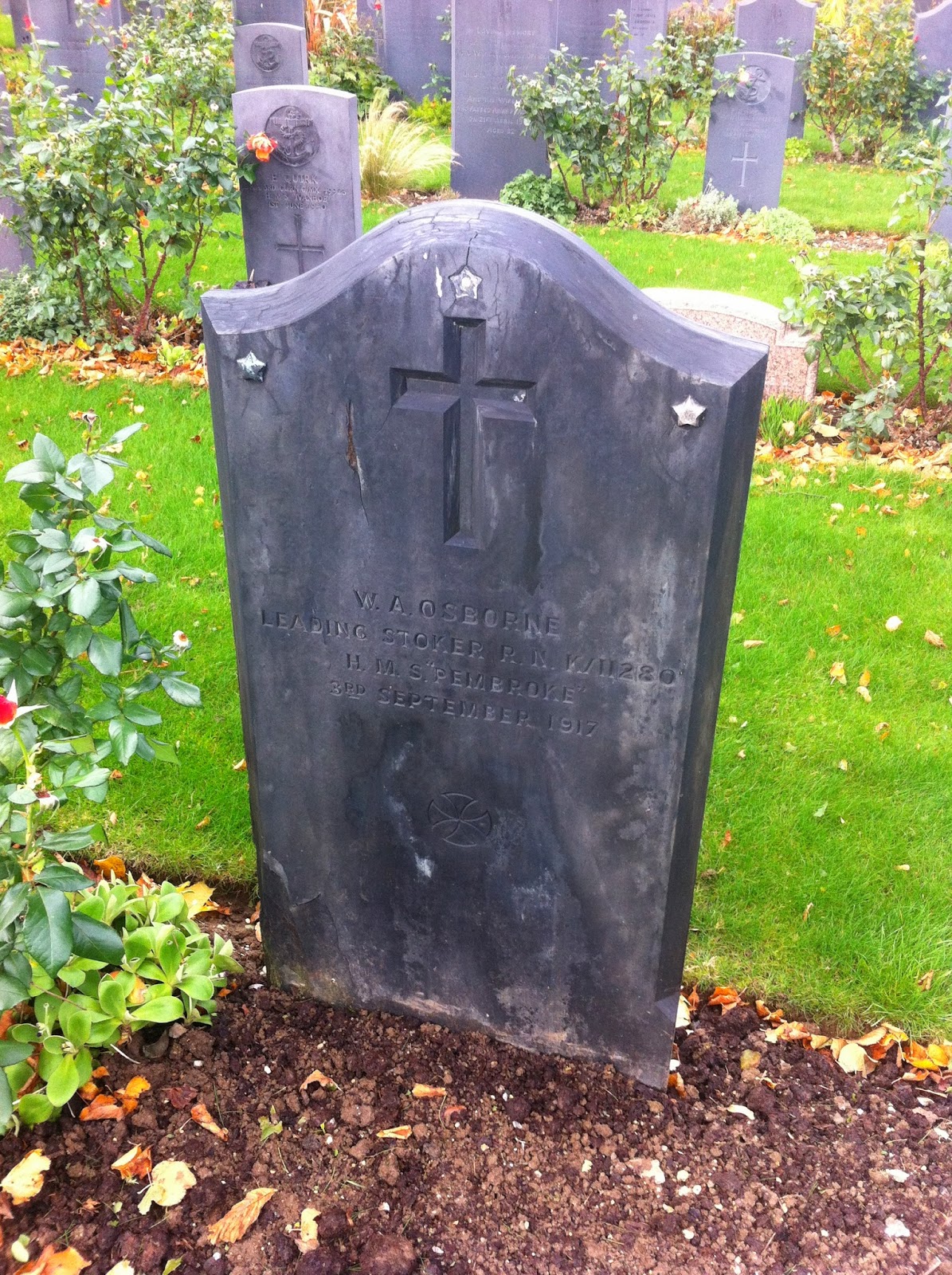
Leading Stoker W A Osborne's grave at Woodlands
Ninety eight of the killed were intered in Woodland's road cemetery in a convoy of vehicles draped in Union Jacks and followed by a procession of men who provided them will a full military burial on the 6th September 1917. Their graves can still be visited today and can be found scattered amongst the many other war dead and those killed on HMS Bulwark.

The names of the 130 are as follows:

A Goddard           J Hammond       W Wakeford
R Mayes              S Hare                E Walsh
J Abrey                F Hartnall          W Walton
J Anderson          T Haville            J Warne
R Anderson         A Haxell             H Wate
H Barker             A Hay                  G Watson
H Bavister           J Henderson       G Wooton
J Beha                 H Hill                  W Gillett
G Bell                 E Hoskins
F Benmore         A Humphrey
J Benson             J Jackson
W Berwick         S Jackson
W Beverley        H Jones
H Bird                A Kennedy
G Boyd              A Langridge
J Brightwell       C Lemmon
M Brown           W Littlewood
W Bullock         J Loose
Engineerman T S Cropley's grave at Woodlands
G Butler            F Lutitt
F Cable             S Macey
A Cairns           A Macgregor
T Carmichael   N Mackay
C Cash              J McGregor

A Charlton       A McLean
R Clark            G McLoughlin
W Clark           J McNish
C Clarke          P Moore
J Clements      A Moss
R Collett         J Nicholson
K Cooke         W Nolan
B Corker         W Osborne
F Crocker        F Parker
T Cropley       W Payne
W Curd           R Peters
F Diver           A Purton
R Ellis            J Raven
A Finlay         F Reyner
L Fish            S Rigden
R Franklin     H Sharp
T Ginn           W Shirley
A Gladwell    G Simpson
H Godden      R Smith
W Godwin     W Smith
N Gooby        W Steed
C Goodsell    A Sutherland
G Gunn         J Venney
S Hadley       A Voice

(Source of names www.Naval-History.net/xDKCas1917-09Sep.htm)

It is unknown how much of this was experienced by young Henry Sams or whether he was in the Drill hall on that fateful evening. He survived the war and served in the Navy into the mid 1920s, mainly around Chatham and Sheppey in training establishments and on Submarines as well as HMS Erebus when it sailed to Arkangel and shelled Bolshevik positions in the White Sea... That however is another story.


Other links:

http://www.merseysiderollofhonour.co.uk/obits/ships/pembroke.htm

http://www.kenthistoryforum.co.uk/index.php?topic=9213.0

http://1914-1918.invisionzone.com/forums/index.php?showtopic=47136

Also; The Gillingham Chronicles by R. A Baldwin, Baggins books, Rochester, 1998.

Photographs (except the Gotha which was taken from Google) were taken by the author.