Saturday, 9 November 2013

Drill Hall massacre in Chatham

A Gothat G.IV in flight
The four biplanes droned through the night sky at sixty miles an hour. The twelve men were a long way from home huddled in their open cockpits and gun turrets talking amongst themselves and keeping a sharp look out for enemy aircraft. The fifith aeroplane had been forced to return to base but the remainder continued on.

Below they passed over an island and suddenly the target became clear. Around the corner of the estuary lay the town of Chatham full lit in the night sky. The pilots changed course and brought the four Gotha G.IV bombers of Kagohl 3 (Kampfgeschwader der Obersten Heeresleitung 3 or commonly known as England Geschwader.) around to face the city and the Naval dock yard. They had crossed the coast at Westgate at 22:35 on the 3rd September and began their approach on Chatham and Gillingham at 22:50.

Following the defeat of the Zeppelins the German Luftreitkrafe began using the new Gotha G.IV bombers for operations against England during the day but wih improving British defences they were forced to swithc to night raids for the first time. This was the England Geschwader's first sortie at night and was totally unexpected.

Security in Chatham had become rather lax. There was no blackout and earlier that day there had been an air raid drill. Local cinemas had shown a news flash that said there would be a further drill later in the day with the Anti Aircraft artillery being fired. Now as the aircraft rumbled over head and the anti Aircraft batteries began to fire people rushed out to get a glimpse of the action and the artillery opening up as part of a drill whilst Soldiers tried to clear the streets.

The Drill hall today
The Germans passed over the Dockyard and the barracks of HMS Pembroke and released two 50kg bombs. Down below them somewhere in the Dock yard was Able Seaman Henry Sams (my Great Grandfather's younger brother) who had been serving on HMS Vanguard up until the end of May.

Due to an outbreak of Meningitus and the ensuing quarintine of the barracks quarters a large number of sailors were sleeping in the Drill hall, as was a group of Sailors from HMS Vanguard who had been rostered to return to the ship before her sinking in July and were awaiting reassignment, this group could have included young Henry Sams.

The 500kg bomb fell through the glass roof and exploded amongst the sleeping men and the blast tore through the open space but due to the Concrete floor mostly redirected up towards the ceiling shattering the glass roof and sending a shower of deadly glass shards down into the men.

Sidney A Moseley RNVR, who was the assistant Mapymaster wrote the following description;

I heard the noise of gun fire and bomb-dropping, but we had grown accustomed to such music, and I did not trouble to stir. In a few minutes, however, a steward came to infrom me that "They were over the building and had dropped a bomb."! Officers, he said, were ordered below.

That bomb, you remember, was one of the few Hun Bull's-eyes. It fell on the top of the men's quarters and killed a large number of the fellows whom I had seen drilling a few hours previously. The Huns were still above the building when I went across to the drill-hall. In the semi-darkness the scenes were weird and soul-piercing But waht was so stirring to watch was the whole-hearted contempt the surviving sailors had for the presence of danger. I believe I was the first officer present, but there was no need to give orders to such men. They worked expeditiously and carefully, removing the debris of broken glass and timber, the dead and the dying bodies of their comrades. [1]

Another witness, Ordinary Seaman Fredrick Turpin described:

It was a gruesome task. Everywhere we found bodies in a terribly mutilated condition. Some with arms and legs missing and some headless. The gathering up of the dismembered limbs turned one sick….It was a terrible affair and the old sailors, who had been in 
several battles, said they would rather be in ten Jutlands or Heligolands than go through another raid such as this. [2]
 
The falling quarter inch thick glass had caused many injuries including decapitations and severing of limbs as well as puncture wounds all the way down to minor lacerations. The clearance operation took until the following afternoon and lasted 17 hours, but only those with thick soled boots could work amongst the shards to rescue the injured or the dead. The wounded were taken to the Naval hospital (now Medway maritime) but the sheer number of injuries stretched the medical facilities available to the absolute limit, they were not prepared for such a disaster.

 A total of 131 men were killed and a further 90 were wounded by the end of it.
 
The bombers had scored a lucky hit, their bomb aiming skills were limited and their equipment exceptionally basic. The flight of Gothas also dropped bombs on Maxwell road (which killed another sailor and the blast knocked his friend and their female companions over), Maritime hospital's grounds, the Woodlands Navy cemetery, on the lines, Brompton school (which was badly damaged), Marlborough road, York avenue, College avenue and a house in May road. There was a fear that poison gas had been dropped as well as a noxious smell filled the air around May road but thankfully it was nothing. However the death toll was the highest caused by any air raid and was the highest that the UK would see until the Luftwaffe returned to the skies above Kent and London some twenty three years later, but even then this was the highest death toll the Medway towns have ever seen.

The RFC scrambled several aircraft to attempt to intercept the enemy aircraft but with a lack of any kind of detection system they were flying blind and all four aircraft returned to their bases in Belgium unaware of the devastation they had caused.
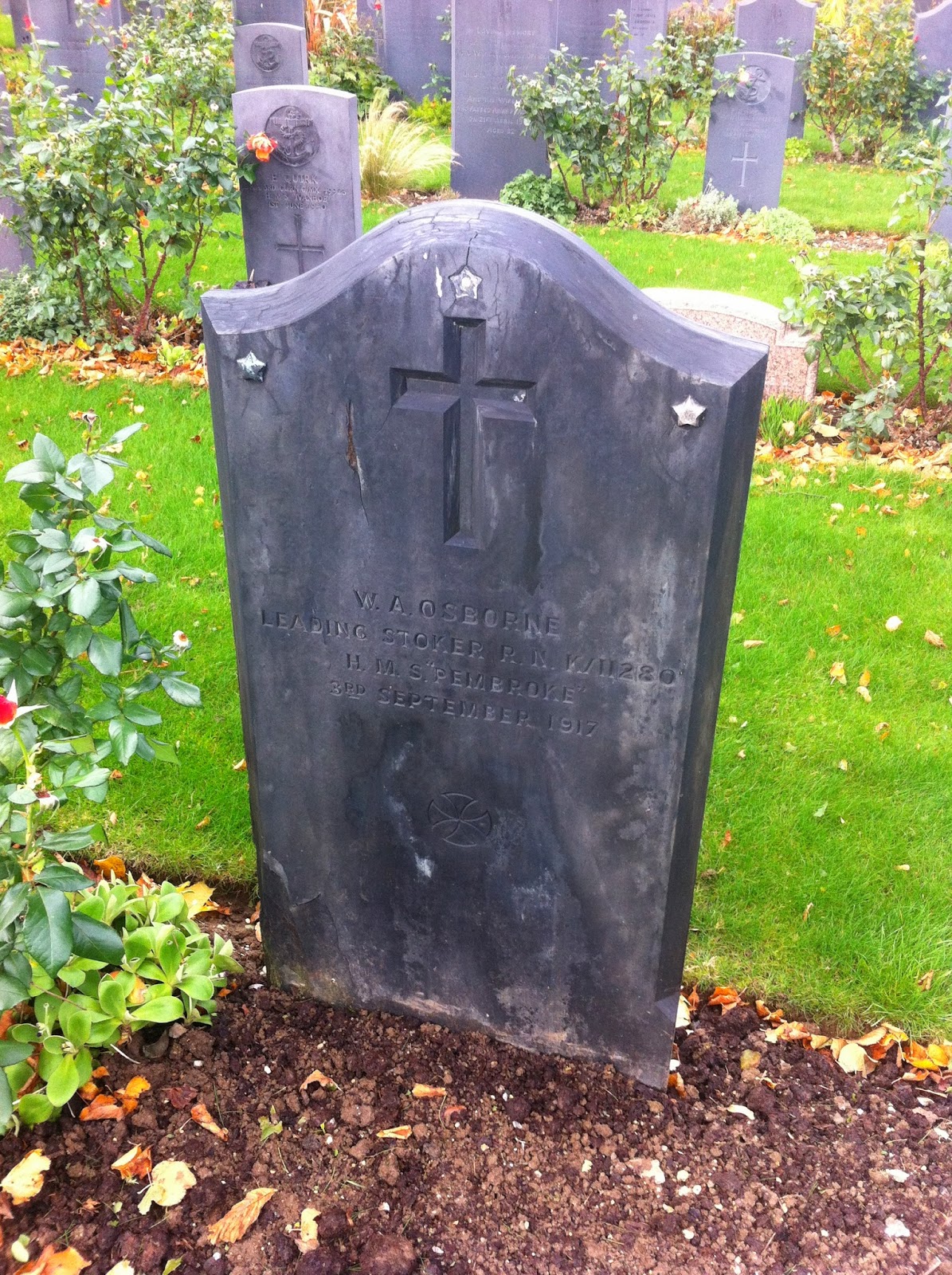
Leading Stoker W A Osborne's grave at Woodlands
Ninety eight of the killed were intered in Woodland's road cemetery in a convoy of vehicles draped in Union Jacks and followed by a procession of men who provided them will a full military burial on the 6th September 1917. Their graves can still be visited today and can be found scattered amongst the many other war dead and those killed on HMS Bulwark.

The names of the 130 are as follows:

A Goddard           J Hammond       W Wakeford
R Mayes              S Hare                E Walsh
J Abrey                F Hartnall          W Walton
J Anderson          T Haville            J Warne
R Anderson         A Haxell             H Wate
H Barker             A Hay                  G Watson
H Bavister           J Henderson       G Wooton
J Beha                 H Hill                  W Gillett
G Bell                 E Hoskins
F Benmore         A Humphrey
J Benson             J Jackson
W Berwick         S Jackson
W Beverley        H Jones
H Bird                A Kennedy
G Boyd              A Langridge
J Brightwell       C Lemmon
M Brown           W Littlewood
W Bullock         J Loose
Engineerman T S Cropley's grave at Woodlands
G Butler            F Lutitt
F Cable             S Macey
A Cairns           A Macgregor
T Carmichael   N Mackay
C Cash              J McGregor

A Charlton       A McLean
R Clark            G McLoughlin
W Clark           J McNish
C Clarke          P Moore
J Clements      A Moss
R Collett         J Nicholson
K Cooke         W Nolan
B Corker         W Osborne
F Crocker        F Parker
T Cropley       W Payne
W Curd           R Peters
F Diver           A Purton
R Ellis            J Raven
A Finlay         F Reyner
L Fish            S Rigden
R Franklin     H Sharp
T Ginn           W Shirley
A Gladwell    G Simpson
H Godden      R Smith
W Godwin     W Smith
N Gooby        W Steed
C Goodsell    A Sutherland
G Gunn         J Venney
S Hadley       A Voice

(Source of names www.Naval-History.net/xDKCas1917-09Sep.htm)

It is unknown how much of this was experienced by young Henry Sams or whether he was in the Drill hall on that fateful evening. He survived the war and served in the Navy into the mid 1920s, mainly around Chatham and Sheppey in training establishments and on Submarines as well as HMS Erebus when it sailed to Arkangel and shelled Bolshevik positions in the White Sea... That however is another story.


Other links:

http://www.merseysiderollofhonour.co.uk/obits/ships/pembroke.htm

http://www.kenthistoryforum.co.uk/index.php?topic=9213.0

http://1914-1918.invisionzone.com/forums/index.php?showtopic=47136

Also; The Gillingham Chronicles by R. A Baldwin, Baggins books, Rochester, 1998.

Photographs (except the Gotha which was taken from Google) were taken by the author.

Sunday, 13 October 2013

Bomben Auf Rochester

Short Stirling bomber like those built at Rochester
Rochester airport, now a familiar landmark, was built in 1933 and Pobjoy opened a factory on the site for
the production of Short aircraft not long afterwards.

Although the 23rd RAF training school was at Rochester from formation (until September 1939 and the outbreak of the war,) there were no active fighter or bomber squadrons on the civilian field. The military fields of RAF Detling, Gravesend and Eastchurch were nearby though and the Luftwaffe intelligence often confused military and civilian fields.

Pre-war the German civil airline,  Lufthansa, flying Heinkel He 111 and Junkers Ju 52 aircraft with covert reconnaissance cameras flew over much of Europe, including the UK photographing many airfields and facilities for the Abwehr. When war started the OKL (the Luftwaffe high command) had photographs of the Shorts factory and the Davis estate which they believed was part of the same facility.

As the Battle of Britain moved to the second phase, the attack on the RAF's airfields, an AufklGr ObdL reconnaissance aircraft flew over the airfield and took another round of photos to update the previous ones.

The first raid was chalked for the 13th August, Adlertag but the Stukas of Luftflotte 2 failed to find the target and instead attacked areas across Kent and Detling airfield.

The airfield had night time defences to stop a Paratroop landing with large wooden poles and anti glider defences that were dragged out every evening. In the day time the local Home guard sat in earthen slit trenches armed with nothing more than rifles whilst two scanned the skies with binoculars. Though nearby palmerston forts at Borstal, Bridgewood and Horsted were fitted witg up to date AA Batteries. 

The complex was on constant standby and the evacuation of the factory happened so often that work was constantly slowed down and almost trickled to a halt.

On the 15th a lone Junkers Ju88 A1 of 5(f) 122 was lost in the Thames estuary having flown another Recon flight over Rochester, its crew were listed as MIA. It was an ominous sign.
Dornier Do.17z bombers of the Luftwaffe

Kampfgeschwader 3 began its attacks on north Kent hitting coastal targets later that day. A large formation of 100 planes crossed the channel between Dover and Deal and proceeded to targets along the coast.

 John Chinery of the local Home guard spotted sixteen Dornier Do 17z bombers descending from the North east at 10,000 ft diving fast and dropping a mixture of high explosives and incendiary bombs. They passed low before wheeling over the residential estate and completing a loop and heading back towards the estuary.

As they approached, scaffold workers nearly threw themselves down their ladders and ropes before fleeing towards their shelters.

The raid took a matter of minutes but  300 bombs had fallen.

The damaged hanger and Stirling aircraft
The damage was extensive. The parts stores were aflame, number 11 Stirling on the runway was torn apart as well as five in the assembly hanger, the office block was also damaged, hangers had lost their roofs but fortunately the main supporting beam did not collapse which saved the rest of the aircraft in the factory. The staff canteen roof had also been destroyed with a direct hit on the car park which did no damage any of the parked cars. The Davis estate suffered five demolished houses and more damaged with a total of 9 injuries but no fatalities.[1]

There was one casualty in the factory. A fireman who was sheltering in a Fire watcher's Bell shelter (generally considered to be fairly safe and constructed of steel) was killed by shrapnel that passed through the wall.

I've consulted the roll of honour for Kent Fire service but have not found any serving Fire officer who died that day so he may have been an employee of Shorts or an auxiliary.

The Stirlings that were lost were;

No.N3645, N3647, N3648, N3649, N3650 and N3651

KG 3. was engaged by 54 Squadron from Hornchurch (Spitfires) and although I am unable to determine which Staffel took part in the raid on Rochester the following aircraft were lost that day.

(Off Reculver) Lt. Kringler's Dornier was brough down by AA fire and RAF fighters. Uffz Depenheuer, Gfr Rohleder and the Kringler were KIA but Obgfr Duda was made a POW.

Same area; Lt. Wlakter, Fw Schauer and Uffz Kirchubel and Pieronczyk were all captured.

A further five planes were lost (four over the estuary and one off Dover) from the unit as they hit targets from Margate, Sheppey, Chatham and Rochester airport unfortunatly the KAHRS had not been able to identify them.

54 Squadron's diary reads thusly;

54 Squadron Operational Record Book – 15 August
4 patrols during the day resulted in 2 clashes with the enemy. By now the order “patrol behind Dover and engage enemy fighters” is becoming as familiar as the old convoy patrols.
Flt Lt Deere claiming a Me 109 destroyed (11:18 hours).


18:28 hours: Flt Lt Deere 2 He 113s. 1 probable was gained for the loss of Flt Lt Deere’s machine when he was shot down in Kent after a flight which has taken him (unwittingly) over Calais Marck! He suffered only a sprained wrist after a parachute jump at 15,000 feet.

On the 4th September the Luftwaffe returned for a second raid. Many workers, suffering from stress and jitters caused by the first raid and the ensuing drills decided to flee to the nearby woods rather than the shelters. Unfortunately the Luftwaffe's incendiary bombs scattered into these very woods, thankfully there was only one fatality and two injuries. The Davis estate took another pounding as did housing around Borstal with six houses completly demolished causing eight injuries.

The damage from the first raid and the prioritisation of Fighter construction meant that Shorts could only think about saving what they could from the wreckage and redistributing Stirling production to other facilities including the underground works at Strood, factories in Swindon and as far away as Ireland. By the following year however, with the skies relatively clear of Luftwaffe action, Shorts returned to the site and began construction of the heavy bombers again.

Bibliography

Aircraft Casualties in Kent Part I, Compiled by G. Baxter, K. Owen, P. Baldock, Published by Meresborough Books, Rainham, 1990.

Kent Airfields, Kent Aviation Historical Research Society (KAHRS), "Rochester" P. MacDougall, Meresborough books, Rainham, 1992

http://www.kenthistoryforum.co.uk/index.php?topic=388.0

http://battleofbritainblog.com/

Wednesday, 2 October 2013

General Lee's report on Gettysburg 1863

After the battle of Gettysburg General Robert E. Lee the Commander of the Confederate Army wrote this letter to Jefferson Davis, the president of the Confederacy.

Headquarters army of Northern Virginia

Near Gettysburg, P.A, July 4 1863

Mr President: After the rear of the army had crossed the Potomac, the leading corps, under General Ewell, pushed on to Carlisle and York, passing through Chambersburg. The other two corps closed up at the latter place, and soon afterward intelligence was recieved that the army of General Hooker was advancing. Our whole force was directed to concentrate at Gettysburg, and the corps of Generals Ewell and A. P. Hill reached that place on the 1st July, the former advancing from Carlisle and the latter from Chambersburg.

The two leading divisions of these corps, under reaching the vicinity of Gettysburg, found the enemy, and attacked him, driving him from the town, which was occupied by our troops. The enemy's loss was heavy, including more than 4,000 prisoners. He took up a strong position in rear of the town, which he immediately began to fortify, and where his re-enforcements joined him.

on the 2nd July, Longstreet's corps, with the exception of one division, having arrived, we attempted to dislodge the enemy, and , though we gained some ground, we were unable to get possession of his position. The next day, the third division of General Longstreet having come up, a more extensive attack was made. The works on the enemy's extreme right and left were taken, but his numbers were so great and his position so commanding, that our troops were compelled to relinquish their advantage and retire.

It is believed that the enemy suffered severely in these operations, but our own loss has not been light.

General Barksdale is killed. Generals Garnett and Armistead are missing, and it is feared  that the former is killed and the latter wounded and a prisoner. Generals Pender and Trimble are wounded in the leg, General Hood in the arm, and General Heth slightly in the head. General Kemper, it is feared, is moortally wounded. Our losses embrace many other valuable officers and men.

General Wade Hampton was severely wounded in a different action in which the cavalry was engaged yesterday. Very respectifully, your obedient servant,

R. E Lee,
General

Saturday, 31 August 2013

George Bone and the British Army 1889-1899

British Soldiers in Peace time uniforms 1870s or 1880s
On the 25th March 1889 in Gosport, George William Bone joined the Regular British Army as a Royal Engineer as he had a trade as a Wheelwright and having served in the South Hampshire Volunteers.

The Army was in a state of evolution and was far from its' completion. Indeed only lessons learnt during the Boer War and again on the bloody fields of France did they finally remove some of the notions and tactics that had been used so effectively against Napoleon a century before.

All Royal Engineers are trained as Infantry men and able to fire their Lee Metford (later Lee Enfield) rifles and cope under fire. They would also be given further training in their field of expertise as well as more general duties and skills.

The Uniforms had moved away from the traditional scarlet towards Khaki which was unofficially adopted in India in the 1950s but spread to General use after the battle of Gennis in 1885. A double breasted tunic was issued and was to be maintained by the soldier. Failure to do so would have led to disciplinary and pay stoppages for wear and tear.

For head gear the home regiments were issued helmets similar to the Prussian Pickelhaube in black with the regimental badge at the front. For active service in Africa and India the more practical Pith helmet was issued. However this was uniformly white and was obviously fairly visible over a distance and so soldiers were allowed to dye them. This was generally done with Tea but by the advent of the Boer War a cloth cover was provided for the helmet.

Gear was to be carried in pouches on belts and valise to distribute weight and allow soldiers to move more freely in combat with the pack as the standard kit carrier being relegated to marches and advances but not necessarily needed on the battlefield.

The Lee-Metford rifle was the standard rifle used by the British soldiers in the 1880s and was used up to and during the Second Boer War. The rifle used the Lee patterned rear locking bolt system which made clearing the breach easier than the predecessor the Henry-Martini as the bolt was above the trigger so the rifleman only had to move his hand a small way before pulling it to 60 degrees rather than the Mauser's 90. This should make the rifle more user friendly and up the rate of fire of the average infantryman. Indeed it had a rate of fire of 20 rounds a minute with the record being 38 aimed shots in a minute! This is despite having a magazine of 10 rounds and would require reloading the bullets which were either individually mounted or on strips of five .303 rounds.

This would have been the rifle George was trained with and used for most of his military career. It was, however being phased out by the time of the Boer war as it was still using black-powder loaded cartridges giving off smoke when fired. As the Metford could not be remodelled for cordite loaded cartridges without regular re-rifling and so an alternative was sought out.

The Lee Enfield rifle was basically the same pattern as the Lee Metford but with a squarer shaped rifling which had a greater durability with the increased heat and pressure of the cordite's reaction.

Both rifles were incredibly accurate over a range of 800 yards for the Lee-Metford and 550 for the Enfield and up to 1800 and 3000 respectively.

British troops were trained to volley fire in tight formation which could provide a deadly wall of fire. This had been standard drill for two centuries and had beaten many an advancing army. At the beginning of the First World War the German army believed that one British unit was solely armed with machine guns when in fact they were just well drilled rifle men armed with Enfields. Independent fire was not taught and soldiers were generally only allowed to fire when told to by their officers thus lowering the rapidity of shot. British officers were also prone to ordering their men to fix bayonets at the beginning of battles thus adding extra weight to the end of the barrel which severely affected their aims. Further to that they were trained to fight in close order infantry formations. These tactics worked against colonial armies at Omdurman where the enemy was lightly armed and would charge en-masse but the Boer would soon prove that an entrenched enemy with modern field guns and with trained marksmen would make short work of these formations.

Barracks life was fairly repetitive with early morning drill and inspection. As a wheelwright he would have been kept fairly busy with maintenance and training of young sappers in how to carry out the trade. As a Corporal he would have aided a Sargent in command of a squad.

Unfortunately, at the moment I know little of his military career beyond the Boer War and although it
Corporal Bone, Second from left, Second row
is possible he had served in India or Africa in any number of colonial conflicts I cannot say for certain.

I have been sent some pictures from his life, which I was exceptionally grateful for, including a picture of him in the Royal Engineer's champion tug of war (Catch weight?) team from Ireland 1897-8.

In 1898 he married Mary Ann Williams in St Mary's Church and together they moved to the Curragh Camp in County Kildare, Ireland where they would have lived in the married quarters or in the communal Engineers barracks. At the Curragh the divisions were hurriedly trained and amassed for the rising trouble in Africa.

As the tensions grew George found himself on a boat bound for South Africa as part of the defencive force to protect British interests.

This was a War that for the fighting man held little interest.Where as World War One would attract a jingoistic attitude, this was another Colonial bush fire to stamp out as far as they were concerned.

Whilst some were no doubt moved by the plight of the Uitlanders or that some of the younger lads were excited to see action I cannot help but think that George had an eye on the horizon and his wife and young son who was born in January 1899. Family myth says that he never saw his boy Albert born but at the moment but he did and didn't depart to South Africa until the summer of that year. It was a long cruise south taking several weeks in which they would carry out ship duties and have morning inspections and maintain their kit. I can't help but think that in the quite or boring times he may have had thoughts about what they would face in Africa, the war, the battles and duty mixed with feelings of regret at leaving Mary and his boy, that he barely knew behind in Ireland.

Saturday, 10 August 2013

SMS Emden and the shelling of Madras

SMS Emden
It was a normal September's evening in the harbour of Madras. Even though the First World War was already tearing Europe apart there were no Central Powers forces to worry about in the far east save for the SMS Emden which was out in the Indian ocean somewhere but her presence was not widely known and she was harrassing merchant shipping,  it was of no concern here.

At about 21.30 a four stacked light cruiser drifted in, her silhoutte looked like a Royal Navy Cruiser like HMS Yarmouth and she coasted lazily into the centre of the harbour.

Then the shooting started.

The German Light Cruiser SMS Emden was the last vessel of the German East Asia squadron in the theatre. Admiral Von Spee had taken the rest towards the Atlantic and the main German high seas fleet. Korvettenkapitan von Mueller had began raiding allied shipping to cause confusion and chaos. With a dummy smoke stack errected and the colours of the Royal Navy Emden looked like HMS Yarmouth, she would quickly swap colours, fire a warning shot and order them to "Stop engines, no wireless."

Now, in a daring move Kapitan von Mueller led his vessel into Madras harbour. Fire was concentrated on the Burmah oil companies storage tanks and after thrity well placed shells they burst into flames lighting up the night's sky.

The German raider's guns were turned on to the vessels in the harbour and the city itself. One vessel was sunk with the death of five crew and twenty six injured. Within half an hour of the attack commencing Emden, already coming under fire from the shore batteries, turned and left the port having expended 125 rounds of ammunition.

The material losses were not great but in her wake Emden left chaos.

Around 20,000 people fled the city [1] fearing that Emden may return with reinforcements, even the governor of Madras did not come to the city until 25th September (three days after the raid) after assurances the Germans had left and even then he did not linger.[2]

The British press did not want to admit that they had lost Emden and that she was still roaming the Indian Ocean unhindered. They also didn't want to publicise how easily a German warship had entered a British port and caused damage.

Their silence did nothing to belay fears of the populous and the exodus continued. Emden became synonymous with fear and cunning, mothers in Ceylon would tell naughty children that the Emden bogeyman would get them. Even today the word Emdena means someone who is crafty and sneaky.

The people of Madras always kept an eye on the horizon for the German's return and did not breathe a sigh of relief until news of her fate reached them on the 11th November 1914, but that is another story...

Friday, 9 August 2013

Who do you think you are?

George W. Bone's enlistment papers in 1889
Wednesday night I saw the episode of the BBCs Who do you think you are? featuring Minnie Driver.

It followed her attempts to find out more about her family and especially her father who had never spoken of his war service. He had, in fact been decorated for his conduct at the Battle of Heligoland Bight in 1939.

Family history is not always as fascinating.

Sometimes you will find generations of Agricultural labourers. There are some nuggets that really catch your eye - or someone who was involved with a major event. Unfortunately this is fairly rare.

Often all you will be able to gain is a snap shot of life from a census, get an idea of age, occupation, dates of birth/marriage/death etc. you can pad it out with some research into trades. For example my Second Great Grand Aunt Ada Williams was a machinist at Chatham Dockyard Ropery according to the 1911 census.

A visit to the site or reading up on the subject would give you a clearer idea of what life entailed for her.

As someone with a fascination for military history I find myself looking at the Soldiers and Sailors in the family - two of whom paid the ultimate price and died for their nation. My Great Great Grandfather George W. Bone who fell in the Boer War and my Great grand uncle Donald Homersham who was killed on the Somme in October 1916 three months after being awarded the military medal for bravery.

When reading around the subject of trench warfare and of the hot bloody fields of South Africa it is easy to draw comparisons to the lives of your family and wonder if they felt the same way or saw the same things.

Despite the frustratingly small amount that can be available for lower class families through history, there is a lot for you to find out, more than you would think. With all the genealogy websites out there it is really easy to get started and to map your family tree out.

As a starting tip I'd suggest you try and get as much starting information is possible such as your parents, grandparents and if possible great grand parents to give you as good a starting position as possible. As Censuses have a 100 year shelving period so the most recent you can get hold of is the 1911 and goes back as far as 1841. Beyond this you have to rely on Parish records for christenings, marriages and funerals which creates a sort of glass ceiling that only those with time and money to go in search of these records.

The other glass ceiling is the pay wall that plagues users. I've tried to do as much for free as possible but I'm hitting the pay wall and hitting it hard. There are a couple of documents that will clear up a lot of questions and the question of how George William Bone died during the Boer War. I do find it fairly frustrating but there it is.

It is something that is fascinating and is a worthwhile thing for at least one person in the family should undertake at some point. It is a sad fact that so much information about our ancestors are lost and anecdotes only last a few generations. 

Wednesday, 7 August 2013

History is all around us

Disused toilets near the Strand in Gillingham
History is a very important subject. It tells us where we've come from, where we have been and what we have done. In some circumstances it can even dictate where we are going.

History is the sum of human experience. If it is not learnt from then you are doomed to repeat it.

History is made by asking five questions; when, where, who, how and why?

Often we know four of the five but one is always a source of contention.

We know when the battle of little bighorn started, we know who led each side,  we know roughly where from the bodies discovered afterwards, we know why but we do not know how Custer's wing conducted itself or how it was defeated.

The truth will always be elusive and open to conjecture.

Local history is something that is all around us, you can't miss it. Not just the castles and cathedrals but also in other areas. The out houses behind the old Chatham Post office is clearly a stable for the stage coaches of old, plaques on houses with dates of construction, grave stones, blue plaques, missing houses in streets - it is all there.

Ever noticed that Gillingham high street has a road like layout with paving slabs on walkways along the side and a wide flat area in the centre? It is where the old tram lines used to run through the town.

You may think that nothing ever happens in the Medway towns but if you scratch the surface we have war, crime, pestilence, famine, death and a role in national and global history. There is something for everyone even if it is one thing that makes you go "huh!"

So how can you get involved or read more?

Well there are many good books in the local libraries any of the book shops in Rochester especially Baggins'.

There is also online resources both amateur and professional. You can check out Medway City ark, The kenthistoryforum and many more - just ask Google a question and the answer will present itself.

These are our towns, they are something to be proud of and generations of people have lived here and made a rich tapestry of events that is fascinating if you but take the time to look into it.

Not into Local stuff - why not take a look at your family? Lots of people get into it to see if they can replicate what they have seen on Who do you think you are? but are often disappointed. occasionally there is something really awesome that makes you think wow other times there is a lot of repetitiveness. It is worth looking into, even if you just go a few generations. There are plenty of Genealogy websites that will help you (for free to a point.) so why not?

History is not the reserve of dusty old professors who do not see the light beyond their libraries, it belongs to all of us and it is waiting for us to grab hold of it.